
IPX Rating Meaning for Speakers: What IPX7 Covers and Where It Stops
IPX7 is a narrower claim than most buyers assume. Here is what the two characters cover, where a sealed mini speaker leaks first, and what to ask a factory to show you.

Most miniature speakers shipped as waterproof carry IPX7 on the spec sheet, and most buyers read that as safe to swim with. The rating is narrower than that: still fresh water, one metre deep, thirty minutes, and the verdict is given after the unit is lifted out, not while it is playing. When an end customer asks whether a speaker can go into the shower, IPX7 answers a different question than the one being asked. The IPX rating meaning for speakers, read literally, is a test envelope rather than a promise about use. This guide separates what the two characters really cover, where a sealed enclosure leaks first, and the four documents worth requesting before a bulk order is signed.
Two Digits, Two Different Tests: What the IPX Code Actually Says
An IP code comes from IEC 60529 and has two positions. The first digit describes protection against solid objects, from a fingertip up to dust, running from 0 to 6. The second describes protection against water, running from 0 to 9K. A mini speaker written as IPX7 fills the second position and leaves the first one blank.
That X is the part most often misread. It does not mean unlimited, and it does not mean the enclosure was tested and cleared. It means the maker did not claim or test solid-particle protection, which is common on speakers because a grille and an open driver cannot be dust-tight while still passing sound. The full code IP67 says both things: dust-tight, and immersion to one metre. IPX7 says only that the water test was passed.
Two practical consequences follow. A quote reading IPX7 tells you nothing about dust, so a speaker sold for a workshop or a beach bag can still clog its grille and its button gaps within a season. And a quote reading IP67 is a stronger claim than IPX7, not a weaker one, which is worth saying out loud when a buyer assumes the shorter code is the higher grade.
Why IPX7 Is Not a Licence to Swim: Immersion vs Splash
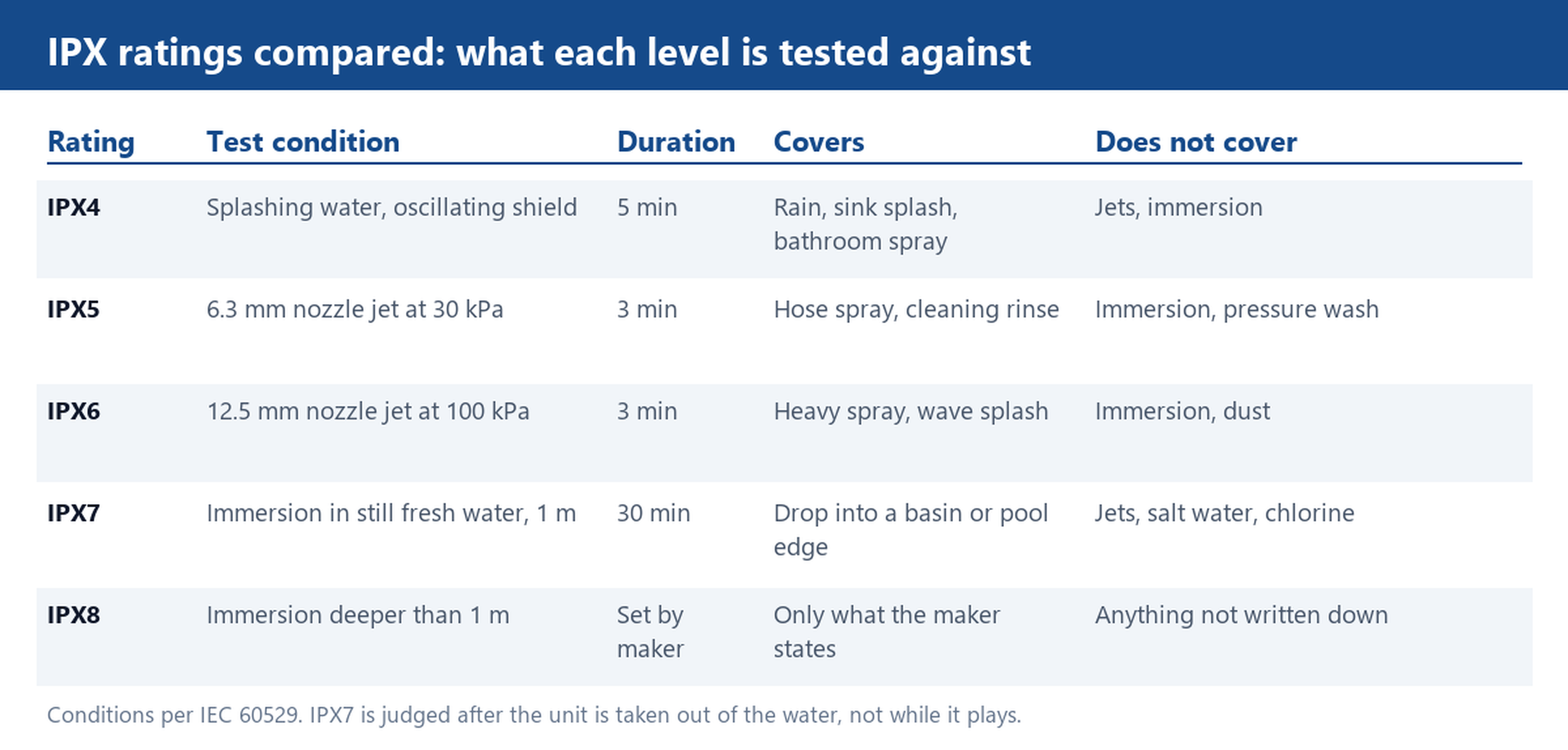
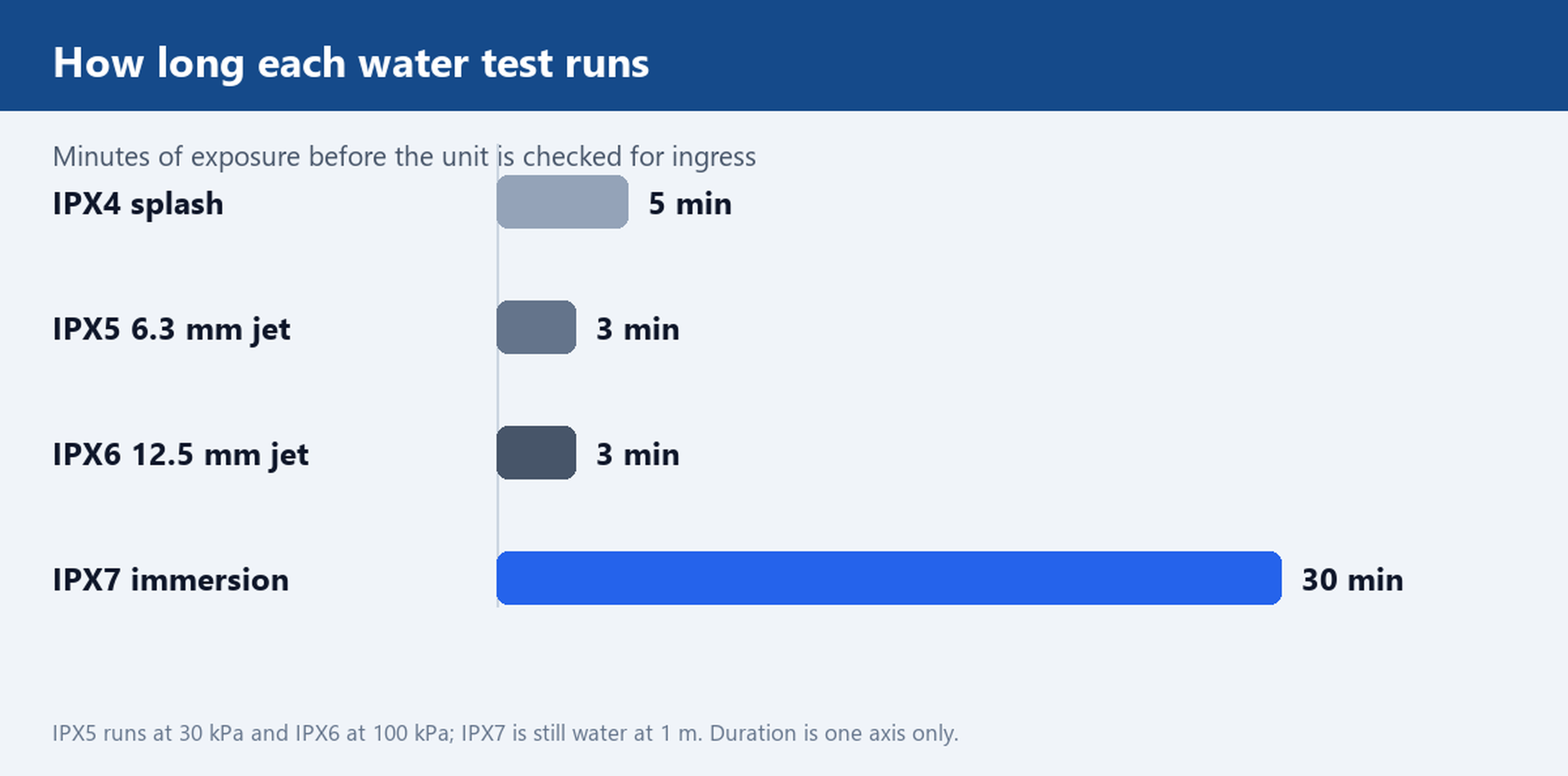
The IPX7 test is immersion, not use in water. The sample goes into a tank of still fresh water with its lowest point one metre below the surface and stays there for thirty minutes. It is then lifted out, dried on the outside, and checked for water in places where it would cause harm, followed by a functional check. Nothing in the standard requires the unit to keep playing while submerged, and in practice it will not: the 2.4 GHz link between phone and speaker does not travel through water.
The next distinction matters more in the field than on paper. IPX5 and IPX6 are jet tests, a 6.3 mm nozzle at 30 kPa for three minutes, then a 12.5 mm nozzle at 100 kPa for three minutes. A jet carries momentum that still water does not. A garden hose held close, a pool jet, or a pressure washer puts more stress on a flap seal than thirty minutes of quiet immersion, which is why a unit rated only IPX7 can fail at a poolside tap while surviving a drop into the pool. A sport model like the IPX7 wireless sport speaker is built around that split: it is sealed for the drop, not for a direct jet into the flap.
Two more gaps are worth naming. The test medium is fresh water, so chlorinated pool water and salt water sit outside the claim, and both attack plated charging contacts and grille mesh over repeated exposure. And IPX8 is not a fixed grade: depth and duration are set by the maker, so an IPX8 line on a quote has to be read together with the figures behind it.
Where a Waterproof Mini Speaker Fails First: Port Covers, Seals, Screws
Almost no IPX7 failure starts in the middle of a shell. It starts at an opening, and on a mini speaker there are five usual suspects.
The charging flap. A silicone plug with a lip is the cheapest way to seal a USB-C port and the first thing to degrade. The failure is rarely the material itself: it is a flap closed over a grain of sand, a tether that has stretched so the plug sits proud, or a flap left open while the unit charges next to a sink. Ask for the flap as a separate moulded part rather than a co-moulded hinge, and check that it seats with a felt click.
The parting line and the ultrasonic weld. Two shell halves joined by a sonic weld leak along a flash line or a cold joint, and the leak is invisible from outside. A sample that passed one soak can fail after a drop that opens a hairline at the seam, which is why a drop test followed by a soak screens better than a soak alone.
Button membranes and the microphone port. Silicone button domes rely on compression at the bezel. A microphone needs a vent that passes air and blocks water; if the vent is a plain hole with glue around it, that hole is the leak path. Ask which vent component is used and whether it is rated as a part in its own right.
Passive radiators and driver surrounds. These usually survive immersion, but standing water in the grille cloth and behind the mesh will mute output until it drains. That reads as a sound complaint rather than an ingress failure, and it is the one buyers report most often as a defect.
Lanyard holes and screw bosses. An open loop through the shell needs its own seal, and a screw that runs into an unsealed boss is a direct path to the PCB. On outdoor models with a carabiner, inspect the loop on a disassembled sample rather than on a render.
Reading IPX7 on a Quote: What to Ask the Factory to Show You
Four requests turn a line on a spec sheet into something a buyer can defend to a client.
1. The test report parameters, not the conclusion. A usable report shows the depth in metres, the duration in minutes, the water temperature and the condition of the sample. For IPX7 the page should read one metre and thirty minutes. A page that only states IPX7 passed does not tell you whether the tank was one metre deep or ten centimetres.
2. A photograph of the opened unit. Water in the battery bay or beading on the PCB is the evidence; a line saying it still plays is not. Ask for the photo taken straight after the soak, before any drying.
3. The seal drawings. Shore hardness of the flap, compression allowance, and whether the gasket is a separate part. This is also where you learn whether the seal is shared across models, which decides whether a change on one SKU reaches the others.
4. A production sample, cycled. Three units from the line, twenty open-and-close cycles on the flap, then the soak. A golden sample proves a prototype; the cycled sample proves the tooling.
One negative rule is worth stating plainly: a certificate of conformity is not evidence of an IP rating. The grade lives in a test report from a laboratory, with parameters and photographs attached. If the sole document offered is a certificate with a logo on it, the rating is a marketing line.
Matching the Rating to the Use Case: Shower, Poolside or Camping
The rating should follow the water the product will actually meet. Over-specifying costs as much as under-specifying, because the money sits in the flap and the seal.
Bathroom and shower. Spray from any direction and steady steam, with immersion as an accident. IPX4 covers the spray, and a mount that keeps the unit above the water line matters more than the code. A shower speaker with a phone stand is the shape most buyers settle on here, because the stand fixes the position of the unit relative to the water.
Poolside and beach. Splash plus a real chance of a drop into water. IPX7 is the right entry point, with two working rules for the end user: retrieve within minutes, and rinse in fresh water afterwards to clear chlorine or salt from the contacts. The waterproof speaker range is where those builds sit; a floating design is a separate decision from the rating.
Camping and hiking. Rain, dew, mud and dust. Dust is the harder problem, so IP67 is the code to ask for rather than IPX7, and a hose-down after a trip is a jet event, which means IPX6 as well. Our outdoor speaker category lists the models built for that mix.
Workshop and job site. Dust, drops and solvent splashes rather than immersion. IP67 again, with attention on the button membrane and the microphone vent.
Promotional giveaways. Cost pressure lands on the flap and the seal. IPX4 with a captive flap is usually the honest specification, and it is a better answer than an IPX7 claim on a unit whose flap the user will lose in the first week.
Across all five, the code is a starting filter rather than a verdict. What decides a repeat order is the seal around the one opening the user touches every day.
Next Step: Send the Use Case, Get the Enclosure That Matches It
Tell us what the product will meet in the field, and we will come back with the rating that covers it rather than the highest number on the sheet. For standard builds, start from the waterproof range; for a different flap, seal or housing colour on the same platform, the tooling route runs through our speaker customisation service. Samples can be soaked, dropped and opened on your side before the bulk order is placed, and the test report parameters come with them. Send the use case and the water it involves through the contact page and we will reply with the model options and the sample arrangement.