


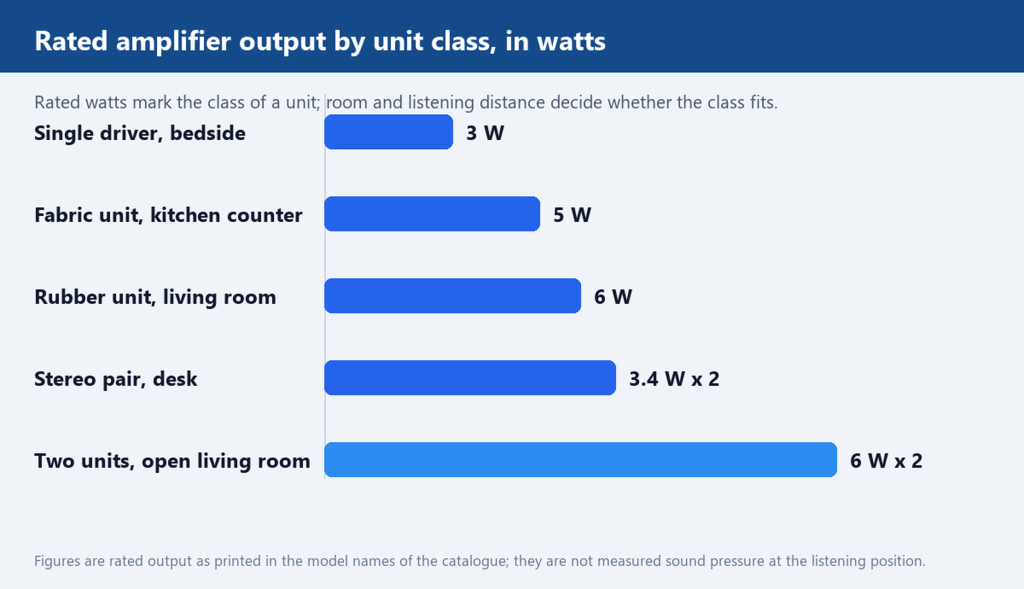
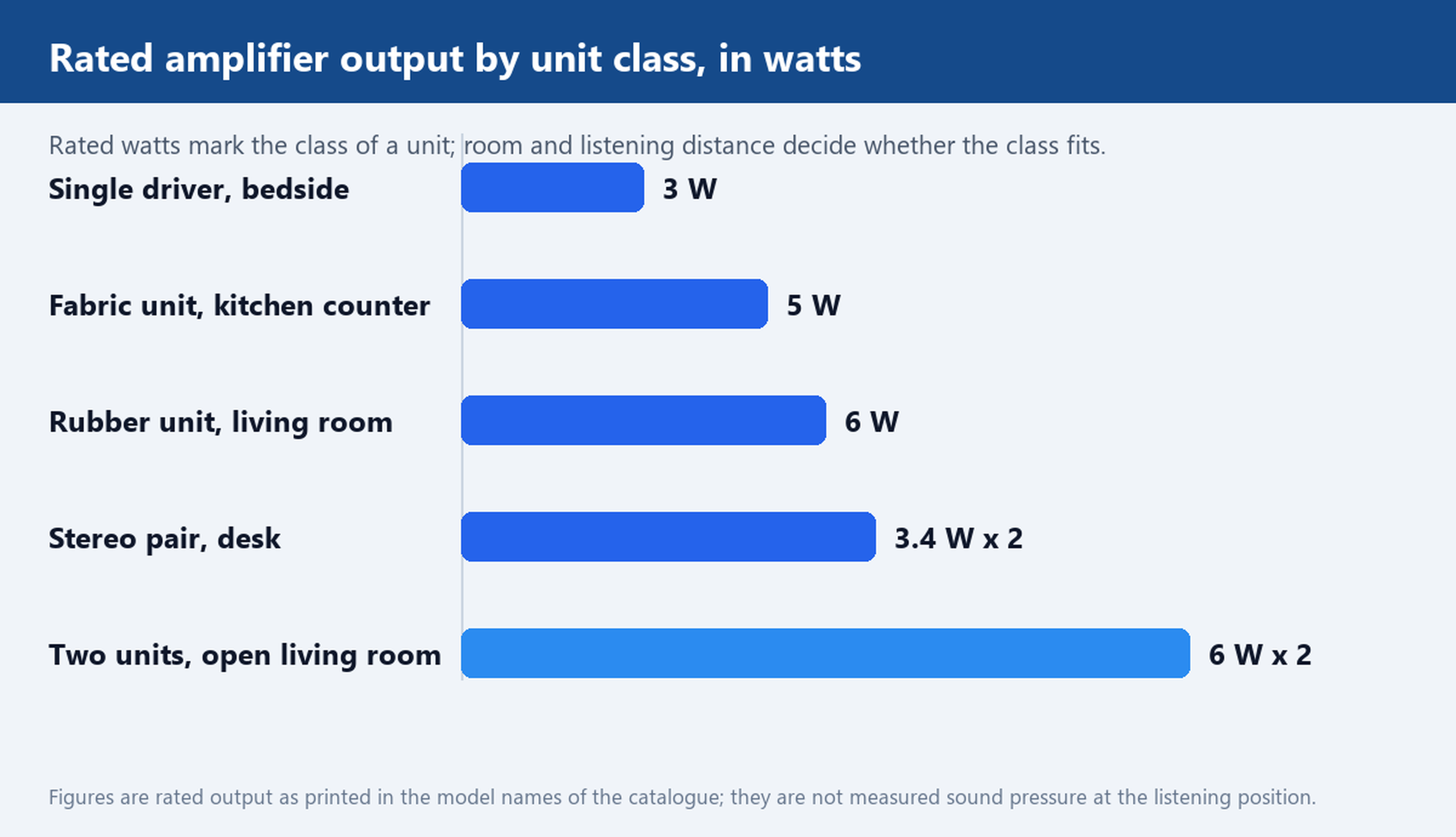
Choosing a bluetooth speaker for home use usually goes wrong on the size question, not the connection question. The unit connects, the pairing works, and the buyer still ends up with a box that disappears under kitchen noise or one that crowds a nightstand that has room for a phone and a lamp. The practical order of decisions is the reverse of what most listing pages suggest: pick the room and the surface first, then read the wattage as a class marker rather than a promise of loudness. A 3 W single driver, a 3.4 W x 2 pair, a 5 W unit and a 6 W unit each have a home in a house, and mixing them up is the most common reason a sample sounds wrong in a real room after it sounded fine on a desk at the office.


Start With the Room, Not the Wattage on the Box
Rated watts tell you how much electrical power the amplifier can deliver into its driver. They do not tell you how loud the unit sounds at the sofa, because loudness at a distance depends on driver sensitivity, enclosure volume and how much soft material sits between the unit and the listener. A 3 W unit with an efficient driver can sound clearer at one metre than a 6 W unit with a heavy enclosure and a thick grille. That is why the wattage figure is a starting filter, not a verdict.
Three variables decide whether a class fits. The first is room volume: a 12 square metre bedroom and a 40 square metre open living area load a small driver in completely different ways. The second is listening distance, measured as a straight line from the driver to the usual seat. Every doubling of that distance drops the level at the ear by roughly 6 dB in free space, and by somewhat less in a furnished room where walls and soft furnishings return some of the energy. The third is program material: speech and podcasts need a clean midrange, while music with sustained bass asks the driver to move far more air.
Write those three down before opening the catalogue. A buyer who says a 3 W unit in a 25 square metre room sounds thin is describing the room, not a defective sample, and a buyer who says a 6 W unit on a desk is too loud at the lowest volume step is describing the same mismatch from the other side.
Bedside and Desk: Why a 3 W or a 3.4 W x 2 Unit Is Usually Enough
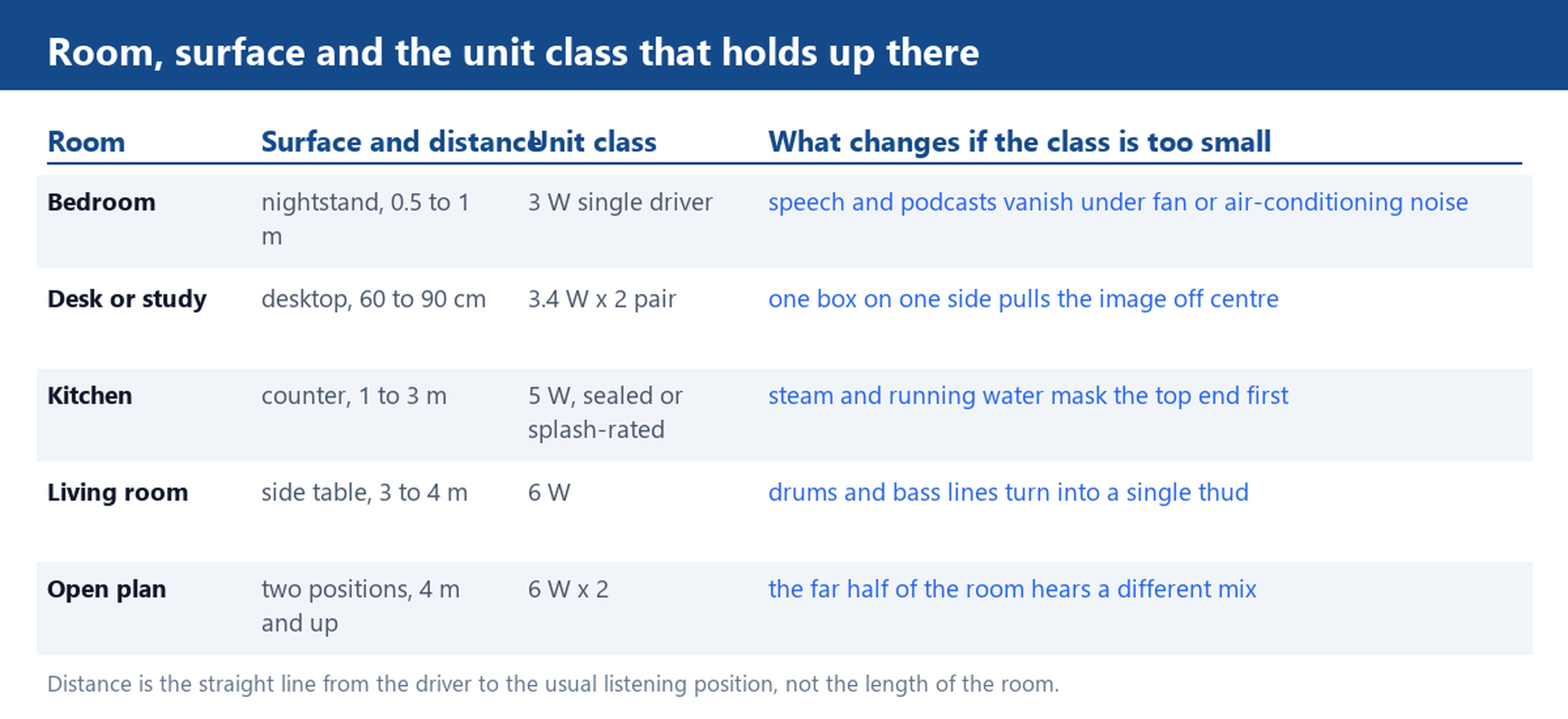
At 0.5 to 1 metre, a 3 W single driver is working inside its comfortable range. Bedroom listening is mostly speech, audiobooks and quiet music at night, and the competing noise is a fan, an air conditioner or a dehumidifier rather than a crowd. A small sealed unit with a 3 W amplifier keeps the midrange forward, which is exactly what the ear needs to follow dialogue, and it does not need to produce the bottom octave that would wake the next room.
Surface matters as much as power here. A nightstand gives you a hard, close boundary that boosts low frequencies and can make a small enclosure sound muddy, so a unit sitting 10 to 15 cm from a wall or a headboard will read warmer than the same unit in open air. If the sample sounds boomy at the bedside, moving it forward is the first thing to try, before any decision about a different model.
The desk is a different case, because the listener is off to one side of the screen and the ears are close together relative to the driver. A single box at the corner of a desk pulls the sound image to that corner, which is tiring over a working day. This is where a 3.4 W x 2 portable model earns its place: two drivers, one on each side of the monitor, with 60 to 90 cm between them, put voices and instruments across the width of the screen instead of in one corner. The per-channel power stays modest, which keeps the noise floor low and late-night listening comfortable.

Living Room and Kitchen Counter: Where 5 W and 6 W Start to Matter
Move the unit to 3 or 4 metres and the arithmetic changes. To reach the same level at the ear, the amplifier has to make up the loss over that extra distance, and the driver has to move more air to keep the low end intact. A 5 W unit covers a kitchen counter comfortably, because the listener is often 1 to 3 metres away and standing near the work surface. A 6 W unit is the more realistic starting point for a living room where the sofa sits 3 to 4 metres from the side table, and it is the class where bass lines and drum patterns hold their shape instead of collapsing into a single thud.
The kitchen adds a condition that has nothing to do with watts. Steam, splashing and grease are the normal operating environment, and a grille that lets water in will fail long before the amplifier runs out of headroom. A sealed or splash-rated enclosure, of the kind collected in the waterproof speaker range, is worth more on a counter than an extra watt of rated output. Check where the charging port sits as well: a port on the top face collects whatever is spilled beside it, while a port on the rear with a tight cover does not.
For a large open plan that combines kitchen, dining and seating in one volume, a single 6 W box will cover one zone and leave the far end sounding thin. The workable answer is a 6 W rubber model with FM radio near the seating and a second unit at the far end, rather than one larger box fighting a room that has no walls to help it. If the seating area is compact and the buyer wants fabric rather than rubber trim, a 5 W fabric model reads as furniture instead of equipment, at the cost of a little headroom.
One Unit or Two: Placement When You Cannot Move the Furniture
Most homes do not allow the ideal placement, so the practical question is what to adjust when the furniture stays where it is. Three placements do most of the work. A unit placed against a wall gains low-frequency output from the boundary, which helps a small unit in a large room but overdoes the bass on a shelf. A unit in a corner gains more of the same effect and usually needs to come out along the diagonal. A unit at ear height, roughly level with the seated listener, keeps the treble from being absorbed by soft furniture and carpet.
When only one position is available, a stereo pair is usually more satisfying than a bigger single box. Two modest units placed left and right of the seating area give width and let each driver work less hard, and a pair of the kind listed in the stereo speaker range will hold a stable image at low volume. Two units also solve the common complaint that a single box at one end of a sofa is audible at one seat and vague at the other.
If the pair runs in true wireless stereo, confirm before the order how the two units link and what happens when one runs out of charge. A pair that drops to a single channel when the secondary unit dies is workable; a pair that stops playing until both are charged is a support call waiting to happen. Also confirm the pairing routine, because a household with several Bluetooth devices will need to re-pair the pair as a pair, not as two separate speakers.
What to Confirm Before the Batch: Battery Hours, Splash Exposure and Inputs
Once the class is settled, the specification questions are the ones that decide returns. Battery hours should be quoted at a stated volume, because a figure measured at half volume tells a buyer nothing about a unit that will run at a level loud enough to cover a kitchen. Ask for the run time at the volume the room actually needs, and for the charging time and port type, since a covered micro-USB port and a USB-C port are a different user experience over a year of use.
Splash exposure should be matched to the room rather than maximised. A bedroom unit needs nothing beyond a dust-resistant grille, while a counter unit needs an enclosure that tolerates steam and a port cover that stays shut. Ratings above the need add cost and can make the enclosure harder to open for service, so match the rating to the surface the unit will actually live on.
Inputs are the last check and the easiest to get wrong in a bulk order. A bluetooth speaker range that also carries AUX, TF card and FM gives the buyer a fallback when a phone is charging or a guest wants to play from a laptop, and those inputs cost little at the tooling stage but cannot be added later. Buyers who are specifying a bluetooth speaker for home use at volume should lock the input set down at the same time as the enclosure, not after the first sample. The compact end of the mini speaker range shows how much variation is available inside a small enclosure, from single-driver bedside units to pairs with a handle and a larger diaphragm.
Tell us the room, the surface the unit will sit on and whether you plan to pair two units, and we will send sample units for a listening test in your actual space before the bulk order. Orders usually start from a short conversation about the room rather than a spec sheet, and the customization page covers the enclosure, colour and branding options once the class is fixed.